Showing posts with label Hot Stove Coal. Show all posts

Wednesday, March 23, 2011

Hot Stove Coal: Retreads Are Never the Answer

I'm sorry that my blogging has been so sporadic. I started a new day job and its duties have had me neglecting my blogging duties. And I was going to be okay with that until I heard this clip of Mike Francesca blowing up at a caller and then saw Michael Kay sitting in full Rangers gear at Madison Square Garden last night. If there was ever a signal that I needed to get back into the blogging game it would be seeing the two New York sports talk blowhards back in my life.
Colon shouldn't be more than a stop-gap for the Yanks(LoHud)

I also wanted to talk about the 2011 Yankees--a rag-tag bunch of characters if I ever saw one. Sure there's the Core Three and A-Rod and CC. But as Spring has gone on, I've seen Yankee fans get excited by the likes of Bartolo Colon, Freddy Garcia, and Mark Prior. It's as American as apple pie to root for comeback stories. We love the guy who rises out of the ashes for one more shot at glory. It's why we go to the theaters to see so many Rocky movies. It's why we the best sports stories always seems to be ones of redemption.

The problem is that we try too hard at times to make something out of nothing, especially when it has to do with baseball retreads (AKA has-beens, washed up, and finished). Sure, there's the odd guy who can have a huge rebound and find his way back to his glory days. But with steroid testing in place, those guys seem to be one in a million. I'm not talking about guys who just needed a change of venue to realize their true potential like David Ortiz, Paul O'Neill, Tim Wakefield or Shane Victorino. And I'm not talking about guys who had a down year or an injury and found a way back the next year. I'm talking about guys whose careers were shot only to find success again. It's just not happening as much as people think.

To prove my point, the Yankees have to look no further than Boston where the Red Sox draw optimisim each Spring from their fans on the retreads they try to revive the careers of. Yankee fans bemoan that their General Manager is no Theo Epstein only to find out that there was a reason these guys were available for so cheap. How much did we hear about Jeremy Hermida, Rocco Baldelli, Brad Penny, John Smoltz, Paul Byrd, Eric Gagne and Wade Miller and how much did they produce? Did you remember that the Red Sox had Bartolo Colon in 2008 or that Freddy Garcia was on the Mets Spring roster before being released? David Wells and David Cone both wore the Red Sox jerseys at some point towards the end of their careers.

Tuesday, February 8, 2011

Hot Stove Coal: Let's Debate Joba Some More

Our own Jay Hyne became the second writer from NYaT to be featured in the LoHud Yankees Blog Pitch Hitter series when he wrote his blog post this morning. He wrote about Joba Chamberlain and Jay believes he should stay in the bullpen. It may all be a moot point at this juncture since Brian Cashman agrees with Jay, but I've stated more than once on this blog I think the Yankees have been making a huge mistake by pigeon-holing Joba into the 'pen. And since Jay did reference our WBRS arguments in his bio, I figured that it was more than appropriate to give some contradiction to his post.
Joba's role has been a debate on NYaT from the beginning (Star-Ledger)

The issue is that while the Yankees seemed to have handled Phil Hughes' transisition to the Majors well (though the jury is still out on that--we'll see after an increased workload this year), they totally bungled Joba. I don't think Jay or anyone would disagree with me on that. He was a reliever, then a starter, then they had him start the first 3 innings of a game, then the shut him down, then he was a reliever, and now he's sort of in limbo. It's tough to be that age and be jerked around like that. I also think that people look poorly upon the season Joba was truly given a chance to start because of how the season ended. Look at his starts before they started skipping him and he was a different pitcher.

Unfortunately, it looks like we'll never know if Joba could have been another Roy Halladay, Zack Greinke or Johan Santana--three pitchers who started as relievers and after a rough start in the rotation, made the transition work. I don't know if it's truly that arm injury or just an organizational-wide mental block against Joba after he burst onto the scene as a dominant bullpen arm. Maybe he'll have to be traded to realize that potential or maybe he's just another Aaron Heilman.

Wednesday, January 26, 2011

Hot Stove Coal: Former All-Star Acquisitions Aplenty in AL East

There have been a lot of former All-Stars acquired by the five teams in the American League East. Here's a look at all those All Stars with one player per team I was surprised wasn't in the Summer Classic (or at least the best player acquired not to make an All-Star Team).

Toronto Blue Jays: Chad Cordero
Surprise: Octavio Dotel

Tampa Bay Rays: Manny Ramriez and Johnny Damon
Surprise: Kyle Farnsworth

Baltimore Orioles: Derrek Lee and J.J. Hardy
Surprise: Mark Reynolds

Boston Red Sox: Bobby Jenks, Carl Crawford, and Adrian Gonzalez
Surprise: Dan Wheeler

New York Yankees: Andruw Jones, Rafael Soriano, Russell Martin, and Mark Prior
Surprise: Pedro Feliciano

The Yankees have the most former All Stars acquired but the Red Sox have the players who have been All Stars most recently. It doesn't really say anything about the teams' offseasons but just a general overview of the starpower assembled this off-season in the American League East.

Monday, January 24, 2011

Hot Stove Coal: Would You Trade Robinson Cano for King Felix?

Felix Hernandez for Robinson Cano and others? This is just a hypothetical, but if Felix Hernandez was available, would you, as a Yankee fan, trade Robinson Cano in a package for him? That was the debate my dad and I just had and I figured I'd open it up to blog discussion.
Should the Yanks give up Cano for King Felix & his Cy? (Seattle Times)

Cano had his best season in 2010 as he vied for the American League MVP award and established himself as one of the top players in baseball and with Chase Utley and Dustin Pedroia, among the top echelon of second baseman in the Major Leagues. He backed up that offense with very good defense and has seemed to really find his own as the #5 hitter in the lineup and as a good teammate in the clubhouse. He hit .319/.381/.534 last season with 29 HR and 109 RBIs and put up a career high 6.4 fWAR.

Felix Hernandez is a unique power pitcher with durability. Young and already incredibly accomplished with a Cy Young (and a second place finish) and to his name, Hernandez is one of the top pitchers in baseball. Besides maybe the Phillies, there is no rotation in baseball where King Felix would not join and be the ace. Over the past two seasons he is 32-17 with a 2.38 ERA, with 8 complete games, 34 starts each season, and an average of 244 innings and 224 strikeouts per season and a 3.18 SO/BB ratio. He has led the league in hits per 9 innings each of the past two seasons. He's put up a total of 13.0 fWAR over the past two seasons.

So that sets up the scenario: would you trade Cano in a package for King Felix? It would probably take Cano plus a few other prospects to get a deal done and all signs point to the fact that Hernandez isn't available, but would you trade the Ribbies from Robby for the Ks from the King? Let us know your thoughts in the comments below?

If you say yes, what would be the maximum package you would be OK with? Would Cano plus Jesus Montero be too much for you? Would Cano plus Montero plus a Killer B be too much? Or would you only do the deal if it was Cano straight up for King Felix? This is a hypothetical so give us your hypothetical in the comments.

Hot Stove Coal: Is This Brian Cashman's Swan Song in the Bronx?

A quick post for this morning, but as I sat there watching football yesterday, I wondered if this could be Brian Cashman's final season as the General Manager of the New York Yankees. We've had this discussion a few times previously only to have Cashman return to the only team he calls home. We've seen his name in the newspapers linked to dozens of teams, especially when the stress of George Steinbrenner's reign seemed to rob him of every one of his remaining hairs. There's a whole section in Buster Olney's "Last Night of the Yankee Dynasty" that is dedicated to Cashman's stress level. But with The Boss having passed, Cashman in control, and a seemingly gentler regime in charge, it seemed like the days of Cashman leaving were well into the future. After the last few weeks of the Yankees' off-season, I'm beginning to think they're closer than we think.
Is this Cashman's final year answering that question in NY?

Brian Cashman has an odd sort of off-season as General Manager. He and the rest of the Yankees management had a very public negotiation (spat?) with the Yankees' captain, Derek Jeter. They put all their eggs into signing Cliff Lee and then watched him make them his third choice in the process. They signed Russell Martin and all seemed to be quiet except for rumors of a possible Rafael Soriano signing. But many of us thought that Cashman wouldn't make a move like that and when he came out and blatantly said he wouldn't give up a first round draft pick for Soriano, we all breathed a sigh of relief.

And then news of the Soriano signing broke. We all wondered what had happened and figured that we would never know if this was a move done by Cashman or by ownership. We figured that Cashman would toe the company line and talk about building that beautiful mythological "Bridge to Mariano" and we would just continue to push out the motto of "In Cashman We Trust".

That didn't happen either. Cashman didn't totally go all Peter Gibbons from Office Space and try to get himself fired, but he did make sure to let everyone know that he wasn't the one pulling the strings of the Soriano signing--even doing so at the press conference with Soriano sitting there. He went so far as to admit to a confused Yankee fan base that he had actually tried to bring back Carl Pavano--the American Idle himself--for another run in Pinstripes. At a time when the fruits of Cashman's drafting and developing labor are starting to ripen, we have to wonder whether he will be around to see the results.

Tuesday, January 18, 2011

Hot Stove Coal: Reviewing Yankees Worst Case Scenarios from 2010 Pt 2

Back in December we took a trip in the time machine back to last off-season and looked at how close the Yankees came to the "Worst Case Scenario" series we did last year. We started with Part 1 and the starting lineup. Well let's continue that with theme today with Part 2, which was the starting pitching staff. By then I realized that non-Yankee fans were taking a lot of joy in my scenarios but it didn't stop me from looking at what would go horribly wrong if the pitching staff fell apart. Let's see how close we got to that scenario:
AJ Burnett was a "black eye" for the Yankees (FanHouse)

CC Sabathia
What I said worst-case would look like: "Alex Fernandez after Marlins won the 1997 World Series...According to Baseball-Reference's Play Index, the hefty lefty is second in innings over the past two years, first in innings over the past three years, second in innings over the past four years, first in innings over the past five years, and over the last decade was 9th in innings pitched despite the fact he was a rookie in 2001. The worst case scenario are that all those innings goes to Sabathia's arm. The guy isn't doing himself a favor by eating so many Subway clubs and if CC fails in his ability to button his pants, it doesn't do the rest of his body any favors. Without CC, the Yankees truly have no ace and it puts a lot more pressure on the other guys."

What actually happened: Sabathia's arm and body held up another year's grind, starting an AL-leading 34 games, pitching 237.2 innings, and winning a Major League-leading 21 games. Sabathia was an All-Star, came in third in the Cy Young voting, and 13th in the MVP voting. He pitched about as well during the regular season as he did in his first year in Pinstripes (with less strikeouts but more groundballs). The issue for CC was when he hit the playoffs. After being stellar in 2009, he was so-so to bad in 2010. He started three times but only pitched a total of 16 innings, giving up a whopping 22 hits and 10 earned runs, striking out 15 but walking 7, hitting a batter, throwing a wild pitch, and being charged with a balk. Sabathia was a huge reason the Yankees made the playoffs (from August 7th-September 2nd he won every time he started), but for them to win the World Series in 2011, they need him to carry it through to the playoffs.

A.J. Burnett

Monday, January 17, 2011

Hot Stove Coal: Yankees Reportedly Close to Andruw Jones Signing

Yahoo!'s Tim Brown is reporting that the Yankees and outfielder Andruw Jones are "nearing a one-year deal." Previously the Yankees were said to be looking for an outfielder who can play all three outfield positions, but were off on salary according to MLBTradeRumors. For the right price, Jones would certainly be a good fit for the Yankees' fourth outfielder, filling in vs. lefties and providing a good defensive and offensive player for the bench. If it isn't a lot of money, I think that Jones is certainly worth the gamble.
Andruw Jones may be heading to the Bronx for 2011 (AJC)

Finding a value for Andruw Jones may be tough, though judging from the fact he signed a $500K deal last off-season with incentives, it doesn't seem to be much of an outlay from the outlook. Even if he gets a raise on guaranteed money from that deal, he's still worth it for the Yankees.

Jones burst on to the scene in 1996 at 19 and killed the Yankees in that year's World Series. From 1998 to 2004, Jones averaged over 30 HR and almost 100 RBI per season while winning a Gold Glove every year. Then Jones really took off. He led the majors in HR (51) and the NL in RBI (128) and a .922 OPS in 2005 when he finished second in the MVP voting (with an 8.3 fWAR) and followed it up the next season with 41 HR and 129 RBI. That was at age 29 and he looked prime to continue on that path. 2007 was a down season for Jones as he hit .222/.311/.413 for the Braves and was scooped up by the Dodgers in the off-season. The Dodgers season was a disaster for Jones and the contract was a bust for the Dodgers as Jones hit an awful .158/.256/.249 before being released. He's been slowly building up his value with the Rangers and White Sox in the American League the past two seasons.

Jones will turn 34 in April and has now been relegated for 4th OF duty. For the Yankees, that may be a perfect place for him. The Yankees have left-handed hitting outfielders in center and left and can use a Marcus Thames-like righty bat for the bench. Thames was a lefty masher last season, and Jones is not too shabby himself hitting .261/.361/.501 vs. lefties in his career and .256/.373/.558 last season. He also had a great second half last season hitting .272/.380/.565 and providing some hope that maybe he has gotten that Hall of Fame swing back.

Thursday, January 13, 2011

Hot Stove Coal: With Money to Burn Yankees Reportedly Sign Rafael Soriano

Sometimes the New York Yankees are reported to make moves that make you hope that it's a mistake and it's not real. That was certainly the case when I heard they had signed Jaret Wright and again was the case when the Yankees re-signed Damaso Marte. The latest report that the Yankees have signed Rafael Soriano to a three-year, $35 million deal leaves me feeling the same way.
Rafael Soriano is thanking the heavens for the Yankees' deal (Newsday)

And judging by the reaction of the rest of the blogosphere, I ain't the only one. According to the New York Times' Tyler Kepner if Soriano opts out after 1 year, he gets $11.5M. If he opts out after year 2, he gets $21.5M total. If he stays all 3 years, he gets $35M. To make this contract worse, after Brian Cashman says that he won't give up his first-round pick for any pitcher on the market, well, he does just that for Type A free agent Soriano. Maybe the money that Cashman didn't give to Cliff Lee was burning a hole in his pocket? Maybe he was getting bored? Maybe Scott Boras and Cash hadn't done much business lately?

Is it the draft pick, the years, the money or Soriano a friend asked? How about all four of those. I don't particularly love Soriano, the draft pick is an extremely high cost for a middle reliever, the years (and opt-out clause) are not friendly to the team, and the money is ridiculous for a non-starter not named Mariano Rivera.

Joe Pawlikowski of River Ave Blues put it best: "The draft pick doesn’t bother me as much as the contract. The Yanks get an expensive setup man for two years before he possibly slides into the closer role after Mariano Rivera‘s contract expires. Though, as we know, you can never count on Mo to call it quits."

The last thing Joe adds is the most intriguing of this all: "The one thing I will add right now: I dislike this move less if it moves Joba back to the rotation."

Wednesday, December 22, 2010

Hot Stove Coal: Soria Would Make Sense...If He's Available

You can't always get what you want. Or so the song goes. The Yankees wanted starting pitching and wanted Cliff Lee. They looked at Zack Greinke. They'll always have an invitation for Andy Pettitte. Now that both of them have gone over to the National League, the free agent and trade market for starting pitchers is looking pretty bleak (at least if you're not a Fausto Carmona fan or a Carlos Zambrano fan as I'm not). The Yankees have money to burn and prospects to trade and, seemingly, nowhere to turn (well, besides Russell Nathan Coltrane Jeanson Martin or extending CC Sabathia). But after trading away Zack Greinke to prepare for the future, it would certainly behoove the Yankees to relook at acquiring Kansas City Royals closer Joakim Soria as a Plan B upgrade to the team.
Soria would look great in Pinstripes (SI)

It's great to want a guy like Felix Hernandez (I mean he is the King), but the reality is that he is (and should be) untouchable. And the Yankees have worked to improve their bullpen signing Pedro Feliciano but Cliff Corcoran of Pinstriped Bible (and others) are right to question how much of an improvement he truly will be. And while a guy like Rafael Soriano would be nice, it seems the Yankees (smartly) don't want to give up a first-round draft pick for him. But while middle relievers are making ridiculous amounts of money (again), the Yankees should look into acquiring Soria, one of the best relievers in baseball--and also someone who is signed to a team-friendly contract. According to Cot's Contracts, Soria will make $4 M in 2011 and has team options of $6 M in 2012, $8 M in 2013, and $8.75 M in 2013 (with a $0.75 M buyout each time and escalators and vesting built in).

This makes him cheap in today's market but the second-most expensive player behind Gil Meche on the Royals roster. And since Meche is untradeable, a team that has conceded they won't be able to compete for a few more years (hence the Greinke deal), Mike Axisa of MLBTradeRumors opined that maybe Soria would be the next out the door. While $4.75 M guaranteed may not be a big burden, a team going no place in 2011 seems to have less need for a ~2 fWAR closer than a team that is trying to win a World Series. That doesn't mean that the Royals will trade him, but they certainly should look into it if it can improve their team when they actually will have a chance to compete.

Now this isn't an unfamiliar target for the Yankees. In July the Yankees reportedly made "a big proposal" for Soria but were shot down. But the Yankees should probably try again. Although the effect of set-up men are quite overrated, Soria has been one of the best (if not the best) reliever over the past 4 seasons. Baseball-Reference lists him as having the highest WAR among relievers while FanGraphs puts him fourth (Mariano Rivera is first). And all this before he turns 27. And with Mariano Rivera signed for two more years, Soria would seem to be a ready-made replacement when Mo decides to finally hang it up*.

Tuesday, December 14, 2010

Hot Stove Coal: Reviewing Yankees Worst Case Scenarios from 2010

I figured today was a good day to revisit a depressing topic. Last winter we launched into a series looking at the Yankees worst-case scenarios for the 2010 season. I didn't expect it to be as popular as it was but it was copied on Yankees blogs, national baseball blogs and even Red Sox blogs. Our three-part series went into what it would look like if everything went wrong. Well, despite winning the Wild Card and making the American League Championship Series, some of these worst-case scenarios actually came to fruition. Let's look at each of them again and see how close we go to predicting the worst-case scenario, starting with Part 1, "The Starting Lineup":
Jeter smiles but the Cold War was predicted back in February (CBC)

Jorge Posada 
What I said worst-case would look like: "Basically 2008 redux. He played in only 51 games, garnering a measly 195 PAs. The Yankees don't need him to get 545 (a number he reached from 2000-2007) but they need him to hit the mid 400s...Jorgie can't get hurt"

What actually happened: Posada played in 120 games and got 451 PAs which was more than he had logged since 2007. The problem was that he hit like 2008 when he played, putting up a .248/.357/.454 line. He also had injury issues like 2008 with a fractured foot in mid-May and a Baker Cyst behind his knee which kept him from crouching. Worse than his offense was his defense which was so bad the Yankees have informed him he is a designated hitter in 2011. 

Mark Teixeira 
What I said worst-case would look like: "The beginning of [2009]. He can't hit and he's killing the team out there..on May 2nd of [2009], Tex was hitting .182/.354/.338 through 99 PAs"

What actually happened: Well, through 99 PAs in 2010 Tex hit .136/.300/.259 and it took him longer to get out of his slump. He still finished with very good numbers but he didn't come close to hitting his 2009 totals. And an injury during the ALCS ended his playoffs and seemed to deflate the entire Yankees' offense. Teixeira still played great defense and got on base during his slump but it took a while for him to come around while he killed the Yankees from the #3 slot.

Robinson Cano

Hot Stove Coal: Yankees Out of Cliff Lee Running; Looks Like Phillies

The last time the Yankees didn't get their man: Greg Maddux in 1992. To tell you how long ago that was, Brett Favre's streak that ended tonight of 297 consecutive starts started way back in 1992. But despite trying to get Cliff Lee at the trade deadline and then offering him a seven-year deal this off-season, Cliff Lee has supposedly decided to spur the Yankees according to many major news outlets (all signs right now point to him going to the Phillies).
It looks like Cliff Lee is heading back to Philly.
According to Buster Olney of ESPN "the Yankees' offer to Cliff Lee was 6 years, $138 million, with a seventh-year player option for an additional $16 million; total $154 M." Lee has supposedly turned that down for a 5-year, $100 M deal with the Phillies who he played for in 2009. In an off-season of Lee or bust, the Yankees have seemed to drawn a blank. Now they must look to their Plan B's as we discussed last week.

While those options aren't great, you wonder if somehow this is somewhat of a blessing in disguise for the Yankees. They never really seemed to want to go to 7 years for Lee and instead of him signing with Texas or the Angels or *gulp* Boston, he is heading to the National League to the Phillies. So if you can't sign him, let's just hope you don't have to face him (and the rest of that ridiculous rotation) until the World Series. The Plan B options may not be great, but the Yankees may be happy about what happened in 5 years. Maybe.

Of course, this is the same Phillies team that traded Lee last off-season thinking they wouldn't be able to sign him to a long-term deal and worried about his injury history. Now he's heading back to team up with Roy Halladay, Roy Oswalt, and Cole Hamels. I think Sandy Alderson wants a Do Over on taking the Mets GM job.

Thursday, December 9, 2010

Hot Stove Coal: Secondary Pitching Options Not Looking Great for Yanks

After the Red Sox broke the bank (or not) for Carl Crawford yesterday, the Yankees have seemed to step up their effort to sign the top player remaining on the market, Cliff Lee, even getting creative on contract details. While I think 7 years for a 32-year-old pitcher is pretty insane, with the Red Sox strikes leaving five lefties in the starting lineup, Lee seems like an even better option than he did a day ago. But what happens if everyone's forgone conclusion is wrong and Lee signs with the Rangers or the Angels or the Nationals or some other team? Well Yankees fans, the secondary options either aren't all that great or aren't all that available. Let's look at these outside "options" (I'm excluding guys in the minors, Ivan Nova, projects like Mark Prior, or a guy like Joba Chamberlain for now).
If Lee disappears, Yankees' options are pretty bleak (Globe & Mail)

To break down possible targets, I used Baseball-Reference's Play Index and looked for any starter who had one season of at least 3 wins (B-R WAR of 3+) in the past three years. Although this is far from a perfect metric, I figured that any starter they acquire probably will need to fit this criteria to be a viable option in the power-hitting American League East. Here's a few candidates:

Zack Greinke: He's probably not a good fit for New York with anxiety issues, but if the Yankees can get some reassurance he'd be okay in New York, I think he's firmly their "Plan B" (as has been rumored). With guys like Jeff Weaver bombing out in New York, I don't know if the Yankees would go this route again, though. I like Greinke a lot: only 27, has been excellent the past three years (though fell of just a bit last year), signed for two more years at a reasonable $13.5 M a season, and seems to want to go to a place he has a chance to win. With chips like Jesus Montero, Brett Gardner, Joba Chamberlain, and young pitchers to play with and a need to rebuild for the Royals, this could be a good match-up player-wise. I just worry about Greinke in the Bronx since "personality" and "adaptability to a big market" are not measurable stats.

Wednesday, December 1, 2010

Hot Stove Coal: Jeter and the Yankees are Taking a While...But That's OK

One of my favorite shows on television is The Office but there are episodes where Michael Scott's interactions with others get so painful to watch that you almost want to turn the channel. The Derek Jeter negotiations are on the verge of that--but aren't there yet. Like Dunder Mifflin and Michael Scott, you feel like the current version of the Yankees and Derek Jeter will always be together, when, in fact, both of those pairings will separate at some point in the not-so-distant future. But in the meantime, Jeter and the Yankees have waged a very public, sometimes uncomfortably messy negotiations for Derek Jeter's last contract. In the end, though, I think that will be okay for both the Yankees and Jeter.
Derek Jeter and the Yankees need each other (MSNBC)

Let's test your Yankees free agent memory: Do you recall the Yankees telling Bernie Williams to hit the road? Do you remember when the Yankees refused to give Andy Pettitte a large guaranteed deal and instead made him play for an average salary with incentives? How about when Jorge Posada and the Yankees had very public negotiations with Jorge threatening to bolt for Flushing? Maybe you'll recall letting World Series "heroes" Hideki Matsui and Johnny Damon walk? All of these happened in the past 5 years and yet the Derek Jeter negotiations are seen by some in the media and Yankee fandom as "unprecedented", when, in fact, the Yankees have already had these types of public negotiations with Derek Jeter, himself, in the past (sometimes those were pretty messy, too).

The Yankees used to operate differently. With George Steinbrenner in charge the Yankees doled out multi-year contracts like they were Halloween candy, never worrying about the consequences or a budget. But after getting bogged down with the Carl Pavanos and Jaret Wrights and, now, A.J. Burnetts of the baseball world, the Yankees are trying not to make the same mistake again. The Yankees' "core" is getting to the point where most teams would send them out to pasture with a shotgun in the pickup but Pettitte, Jeter, Rivera and even Posada can all serve a purpose to a Yankees team trying to win in 2011. They all have meant a lot to the Yankees teams of the past and have been well-compensated for that, but can still contribute to a winning team in '11.

Thursday, November 4, 2010

Hot Stove Coal: Should the Yankees Trade An Outfielder? (Nick Swisher Edition)

I know, I know: the report today from Mark Feinsand of the New York Daily News is that the Yankees are out of the Carl Crawford and Jayson Werth sweepstakes. But I don't believe that for a second. The Yankees were also out on Mark Teixeira and look what happened there. Plus, I've already gone through the rest of the outfield having covered Brett Gardner and Curtis Granderson. So let's finish up the series and see if the Yankees should keep or trade their righfielder (and about-to-be-married-man), Nick Swisher.
Swish was a Yank for 2 postseasons; will he be around for a 3rd? (LoHud)

When the Yankees acquired Nick Swisher after the 2008 season, it was seen as a reclamation project. After putting up 3+ win seasons for the Athletics in 2007 and 2008, Swisher had struggled playing under Ozzie Guillen and looked like he needed a change of scenery. The Yankees acquired Swisher for three bags of baseballs players: Wilson Betemit, Jeff Marquez and Jhonny Nunez. He was owed just over $22 M for the next three years or $31.3 M for the next four depending on the option the club controlled. Swisher was originally acquired to be the Yankees everyday first baseman until the Yankees surprised many and signed the aforementioned Teixeira to a long-term deal. Suddenly, with first filled by Tex and the OF/DH spots all covered, Swisher was relegated to a bench role. That quickly changed in April of 2009 as Swisher's hot start combined with a Xavier Nady injury got Swish into the lineup everyday in rightfield. And since that time he's been one of the Yankees most important players.

After putting up 3.3 WAR last season in helping the Yankees win the World Series, Nick Swisher had the best season of his career, putting up a WAR of 4.1. Although Swisher became more free swinging and walked less in 2010 (only 9.1% of the time, a far cry from 16% last season), he improved his average (career high .288) and slugging numbers and combined that with improved defense in right. He seemed to come into camp in much better shape and besides a late-season knee injury, seemed to be playing with much better comfort in the field. He was also moved around quite a bit in the lineup, filling in the second slot at times and moving further down in the order at others (he batted in every slot except lead-off).

Wednesday, November 3, 2010

Hot Stove Coal: Should the Yankees Trade An Outfielder? (Curtis Granderson Edition)

Yesterday we looked at whether the Yankees should trade Brett Gardner to make room for Jayson Werth or Carl Crawford. The overwhelming response seemed to be against it. But let's move around the outfield and check out Curtis Granderson. Although heading into September it looked like there was no way the Yankees could trade The Grandyman, a strong end to the season coupled with a really hot playoffs could change some minds. But is it enough to make it worth trading Granderson? Let's take a look.
In the end, The Grandy Man could for the Yanks in 2010 (NYP)

Curtis Granderson came to the Yankees with great expectations, having been traded for much-heralded prospect Austin Jackson and two pitchers who were on the Major League team in 2009 (Ian Kennedy and Phil Coke). So when Jackson (and Kennedy) hit the ground running and Granderson failed to produce at the beginning of 2010, many saw it as a bust. And they weren't so far off. Although he missed most of May, Granderson wasn't missed much in the Yankees lineup as he hit .233/.302/.392 through July 20th with only 7 HR and 24 RBI. Part of Granderson's problem was a BABIP one, but at times he looked just plain overmatched at the plate. He was awful against lefties and wasn't much better against righties and his inability to get on base was making his speed worthless.

But as the season went on things started to click. Granderson hit two solo homers on July 25th against the Royals and including that win, Granderson would hit .255/.342/.557 the rest of the season with 17 HR and 43 RBI. But at the time he wasn't hitting southpaws. Anyone who watched Yankees games all season could see that Granderson's swing was too long and had too many moving parts and after swallowing his pride and working with Kevin Long in August, Granderson turned around his season against pitchers regardless of which side they threw from. From the New York Times' piece on Kevin Long we linked to a few weeks back "with a shorter swing, Granderson hit more homers (14 to 10) and drove in more runs (34 to 33) over his final 165 at-bats than he did in his first 301." September was Granderson's best month of the year as he hit .263./.362/.596 with 9 HR and 25 RBI.

His hot hitting spilled over to the playoffs where Joe Girardi started him regardless of what hand the starter was going to be pitching with and he rewarded Girardi's faith with a big hit in Game 1 of the ALDS. In the Yankees 2010 postseason Granderson hit .357/.514/.607 with 4 XBH and 6 RBI. He also had 8 walks (and one HBP) to only 5 K. Although the Yankees were eliminated, Granderson went from zero to hero for the Yankees and a lot of credit has to be given to him for his willingness to adjust mid-season when needed. Overall Granderson put up a WAR of 3.6 for the regular season which was his highest output since an amazing 7.4 in 2007. Although he got terrible jumps for much of the season, Granderson finished eighth in the Fielding Bible Awards for centerfield and had an UZR of 5.3 which was his first positive output in the past three years. And although we don't get to see the inner workings of the clubhouse, Granderson seemed to fit in well there and his adjustment to New York was completed in the playoff run.

But will the Yankees keep him in the clubhouse in 2011?

Tuesday, November 2, 2010

Hot Stove Coal: Should the Yankees Trade An Outfielder? (Brett Gardner Edition)

The World Series is over so it's time to fire up the Hot Stove Coal series once again. Last off-season the Yankees passed up on bidding for Jason Bay or Matt Holliday. Some of the thought behind that was that they would wait one season and bid heavily on Carl Crawford or Jayson Werth, both seen as better options for the Yankees than last year's duo. But with free agency about to descend upon us, the question has to be asked: do the Yankees have any interest in acquiring an outfielder? And if that answer is yes, who do the Yankees trade in the outfield? We'll take a look at each of the Yankees outfielders over the next week but let's start in leftfield with Brett Gardner.
Brett Gardner's defense was huge for the Yankees in 2010 (Star-Ledger)

It's funny to look back at the uproar that was caused by the Yankees not signing Holliday or Bay, trading away Melky Cabrera, and handing the leftfield job to Brett Gardner. Even the prognosticators saw Gardy as only slightly improved on his 2009 self. Gardner responded by hitting .277/.383/.379 with a .358 wOBA and 47 SB. Almost as impressively, Gardner's defense was among the best in the game. He won the Fielding Bible Award in a 10-point upset over 3-time winner Carl Crawford. Mike Axisa of River Ave Blues followed that up by writing: "it didn’t factor into voting, but Gardner did finish with the highest UZR (+22.3) and UZR/150 (+39.7) in baseball this season, regardless of position." He also set the record for most pitches per plate appearance (since the stat has been tracked). All this added up to 52.1 runs above replacement which was roughly 5.4 wins, good for 9th among American League position players according to FanGraphs, ahead of such guys as Joe Mauer, Ichiro, Victor Martinez, and any Yankee besides Robinson Cano (which means he also produced the greatest value relative to his salary). Baseball-Reference was slightly less kind, putting Gardner at 4.0 WAR, though his defensive WAR was 7th in the American League among position players putting him into the upper echelon.

The problem with Gardner is that he needs to duplicate that success of getting on base to be successful. Gardner was on a tear early in the season, hitting .321/.403/.418 through the end of June. That also coincided with the time that Clayton Kershaw nailed Garnder with a 91 MPH fastball on the right wrist. Although X-rays came back negative and Gardner said he felt better, his results after that told a different story. Gardy hit .232/.363/.340 the rest of the season and really seemed to struggle to drive the ball. In mid-September an MRI showed considerable inflammation in that wrist and he received a cortisone shot. Although he hit a little better the rest of the regular season, his bat was dead in the playoffs as he hit .185/.285/.185 in the postseason with no extra-base hits, 2 SB, 8 K and 3 BB. Although he still saw a lot of pitches, he looked like he was unwilling to swing the bat until absolutely necessary, making some wonder if his wrist was not bothering him some more. And it sure didn't help that C.J. Wilson supposedly stepped on Gardner's left hand when he slid into first on that fateful play in Game 1 of the ALCS.

Monday, February 8, 2010

Hot Stove Coal: Randy Winn Finalizes One of the Strangest Contracts

Brian Cashman said he had $2 million to spend on a leftfielder and it looks like he will do that one way or another. The report came out today that Winn's contract is only for $1.1 M and with the $900,000 Thames will get if he makes the Major Leagues, that makes $2 M. But if Thames doesn't make the roster, Winn will be able to make $2 M all by himself. How? Let the AP explain:
Randy Winn and the New York Yankees have finalized a $1.1 million, one-year contract.

The outfielder can earn an additional $900,000 in performance bonuses based on plate appearances against left-handed pitchers. He would get $100,000 each for 50, 75 and 100, and $150,000 apiece for 125, 150, 175 and 200.
Winn better hope that he gets lots and lots of ABs against lefties; he has an 82% bonus riding on it. My guess is that Cashman and the Yankees will either see an ability in Randy Winn to hit lefties in Spring Training and if he can, they'll take Winn and Jaime Hoffmann (who makes very little) and if  he can't as they expect, then Thames will come along as a bench bat. This is what we in the financial world call "insurance".

Hot Stove Coal: Yankees Sign Marcus Thames

I knew they weren't done with leftfield. The Yankees have signed outfielder Marcus Thames according to SI.com's Jon Heyman (via Twitter). The money has not yet been disclosed but Thames will compete with Jaime Hoffmann for the 5th OF spot on the Yankees. It would make sense to bring in Marcus Thames on a minor league deal or the league minimum and then just to let go of whichever one of Hoffmann and Thames don't make the roster after Spring Training.
Thames was once a Yankees' prospect who hit his first major league home run off of Randy Johnson and was traded for Ruben Sierra (the second time). Now Thames comes back to the place where it all started. Thames is now the third Yankee to be reacquired by the Bronx Bombers this off-season (Javier Vazquez and Nick Johnson the other two). Here's what I said about Thames a month ago:

Marcus Thames:
  • Pros: Once a Yankee and the Yankees seem to be in the habit of acquiring their former players. Has pop from right side. Has career .845 OPS vs. lefties.
  • Cons: Not a good fielder. Has posted a UZR of -16.7 in 1766 innings in LF. His career OBP is .306. .233/.281/.461 against righties make him only a platoon option.  
MLBTradeRumors writes that Thames "hit .263/.326/.541 against lefties over the last three years." Thames would seem to be a good bench bat with some pop who could play in place of Curtis Granderson when the Yankees face a tough lefty. Rebecca at This Purist Bleeds Pinstripes says that it's a good time use FanGraphs fancy new splits, though I'm more interested in his righty/lefty ones. And for that reason, this signing makes sense.

Update: Some financial numbers from The New York Post's Joel Sherman via Twitter: @nyp_joelsherman: #Yankees sign Marcus Thames to minor league deal, gets $900,000 if makes team.  That's what I was talking about when I said the Yankees needed some cheap competition for Hoffmann.

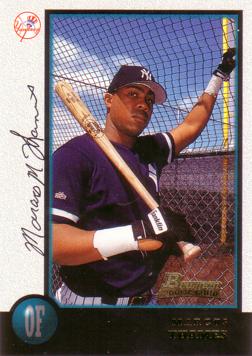
Picture from homeruncards.com

Hot Stove Coal: Predicting the 2010 Cy Young Winners

Spring training is right around the corner, so I thought it would be a good time to look at some early predictions for Cy Young Award Winners. FanGraphs has projections from CHONE, Marcel and Fans on their website and I plugged that predicted data into the Rob Neyer/Bill James Cy Young Predictor. Unforunately, data like shutouts and division winners were not available for this and saves were not available for CHONE, so there were some modifications needed.

Closers are left out of CHONE completely so take that into account when you see the candidates. I took the 3rd best candidate from each league and subtracted 16 from each starter (12 for the division winner bonus and 4 as a generous number for shutouts) and 12 from each closer (just the 12 for the division winner and of course left out of CHONE) to figure out who would even have a chance of being in the Top 3. Again, there's no science to this method. And Cy Young Predictor (CYP) is not an exact match for the Cy Young. Last season, Zack Grienke was ranked 2nd in the AL and Tim Lincecum was ranked 4th in the NL. But I figured putting this many candidates out there would give a pretty good base of who the projections think will be in the discussion. And I left stats like ERA, WHIP, K/9, BB/9, and K/BB just for comparison.

Let's get started:

AL Cy Young Candidates - CHONE
Name IP ER SO W  L ERA WHIP K/9 BB/9 K/BB CYP
C.C. Sabathia 205 80 177 15 7 3.51 1.20 7.77 2.20 3.54 124.64
Javier Vazquez 195 83 182 14 8 3.83 1.22 8.40 2.31 3.64 108.50
Jon Lester 181 73 167 13 7 3.63 1.28 8.30 3.03 2.74 105.47
Zack Greinke 192 71 188 12 9 3.33 1.19 8.81 2.30 3.84 105.33
Felix Hernandez 200 74 183 12 10 3.33 1.23 8.24 2.84 2.90 104.36
Josh Beckett 187 80 174 13 8 3.85 1.23 8.37 2.21 3.78 100.39
James Shields 199 84 148 13 9 3.80 1.20 6.69 1.90 3.52 98.89
Cliff Lee 197 76 148 12 10 3.47 1.19 6.76 2.06 3.29 97.78
Justin Verlander 193 79 190 12 10 3.68 1.24 8.86 2.89 3.06 96.06

Friday, February 5, 2010

Hot Stove Coal: Derek Jeter and Johnny Damon Saw a Whole Lot of Fastballs in 2009

The Yankees #1-#4 in their lineup last year was one of the best parts of their team. Derek Jeter, Johnny Damon, Mark Teixeira and Alex Rodriguez helped to fuel the Yankees potent offense as each enjoyed good seasons. The success of this part of the lineup only took off, however, when A-Rod came off the disabled list. He provided protection for Teixeira who started to hit, and Teixieira in turn provided protection for Damon who started to hit, and Damon then did the same for Jeter. Today Buster Olney produced an interesting list on ESPN.com from Inside Edge on the player whose preceding batter received the most fastballs in 2009 (also known as the players who provided the best protection). Here was the top of the list:
1. Adam Jones: 73.7 percent
2. Denard Span: 73.3 percent
3. Joe Mauer: 71.9 percent
4. Mark Teixeira: 71.3 percent
5. Johnny Damon: 71.3 percent

6. Dustin Pedroia: 71.3 percent
7. David Wright: 71.1 percent

As you can see, two Yankees are in the top 5 and if you take the normal Yankee order, that means that #1 and #2 in the Yankees 2009 order each received about 71.3% fastballs when they batted. But was that because of the protection they received or how they hit fastballs? Let's take a look (stats from FanGraphs, knuckleball data excluded since hitters see it very little):

Derek Jeter: 64.1% Fastballs in 2009, 10.1% BB%
Career runs above average/100 pitches on Fastball: 0.98
2009 runs above average/100 pitches on Fastball: 1.61
Best runs above average/100 pitch for career: Split-fingered Fastball (2.47)
Best runs above average/100 pitch for 2009: Curveball (3.67)

Johnny Damon: 64.8% Fastballs in 2009, 11.3% BB%
Career runs above average/100 pitches on Fastball: 0.75
2009 runs above average/100 pitches on Fastball: 0.53
Best runs above average/100 pitch for career: Curveball (1.85)
Best runs above average/100 pitch for 2009: Cutter (4.09)